The North Pole—a tempting prize for Russia?
Original title: Der Nordpol - ein Leckerbissen für Russland?
The Arctic’s melting ice currently offers a striking example of why economic profit usually takes precedence over the environment.
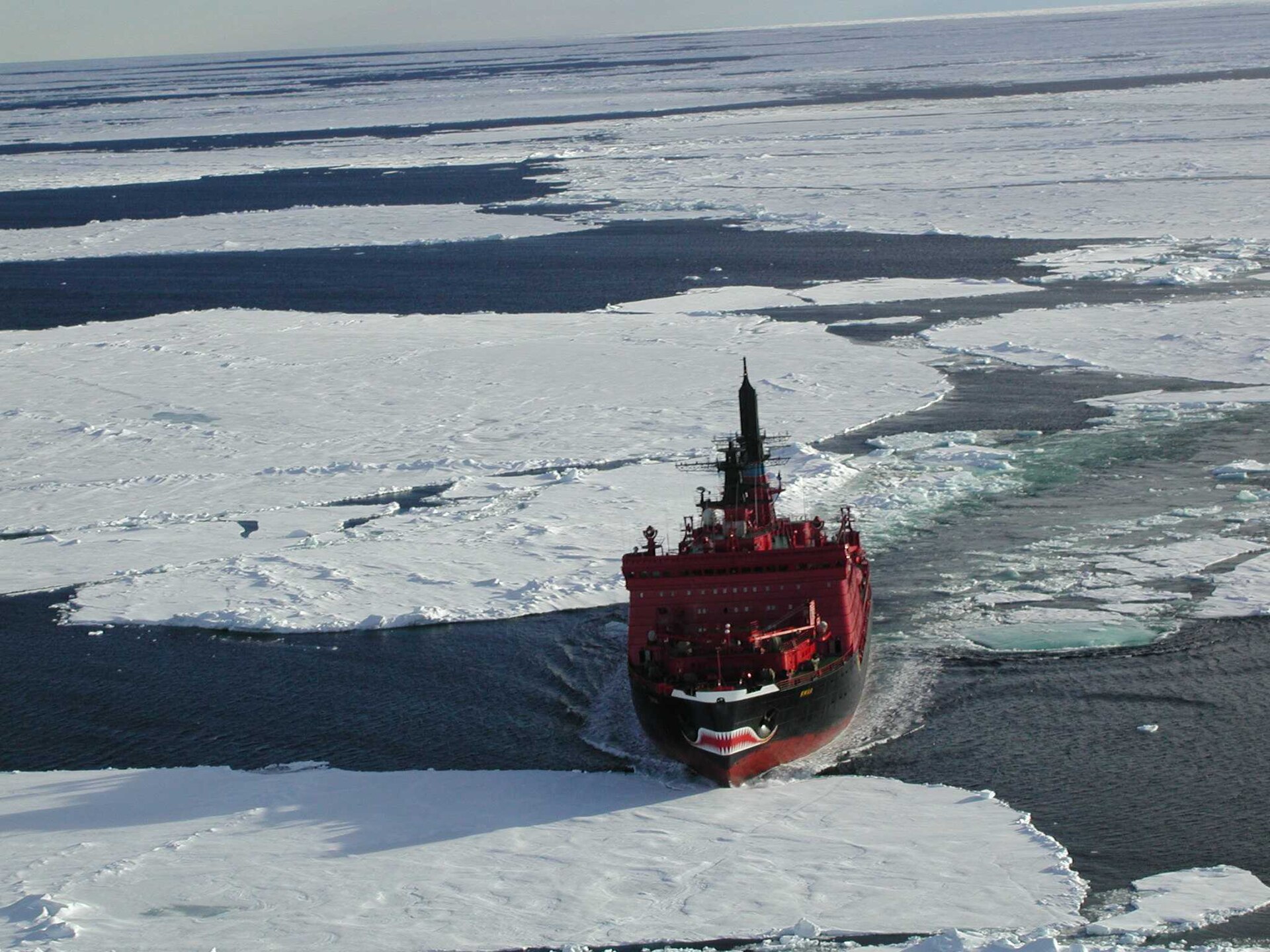
Hard as it may be to acknowledge, climate change has positive aspects—at least when it comes to extracting more natural resources. This time, the focus is the Arctic. The roughly 27-million-square-kilometre northern polar region is melting substantially each year, gradually making accessible oil—an estimated 90 billion barrels—and natural gas previously protected by permanent ice. Around 25 to 30 per cent of the world’s fossil fuels are said to lie primarily north of the Arctic Circle. It is therefore hardly surprising that this development, fundamentally harmful to the global climate, is attracting considerable attention—but not necessarily in the interests of sustainability. The North Pole is not only about oil or new fishing grounds, either: it also has security-policy significance.
Russia has been increasing its military presence in the Arctic for years. Moscow currently maintains seven permanent naval bases in the northern polar region, equipped with modern anti-aircraft missiles. Economic interests, after all, need to be secured. Russia hopes that the future Northern Sea Route connecting Europe and Asia will run through Russian territory, becoming a competitive trade-route alternative to the Suez Canal and the South China Sea.
Other states also have claims to Arctic territory, however, including Canada, Denmark, Norway and, not least, the United States. These are documented by the United Nations, yet the northern polar region remains the only region in the world whose final boundaries have never been completely settled. There is, of course, no doubt that the United States and other NATO countries are closely following the Kremlin’s political manoeuvres: why leave the Arctic to Russia when they could derive economic benefit themselves? Quite apart from this, the Kremlin’s military expeditions are currently all regarded as security risks.
It remains to be seen to what extent a race for Arctic resources will develop in the coming years. One thing is certain, however: the ice in the northern polar region is melting, and Pandora’s box will soon be opened.